November 5, 2026

Fifty-four percent of C-suite executives told Writer's 2026 enterprise survey that AI is tearing their company apart.
Before you read that as a technology failure, ask a simpler question: who, by name, is accountable for what AI delivers across your whole company?
If you had to think about it, you have your answer.
AI didn't arrive through a strategy. It arrived through a hundred sensible purchases.
A department head found a tool that saved her team a day a week. A director built an automation over a weekend. A vendor added an assistant to software you already paid for. Each choice had an owner. Each owner could defend it.
Now add them up. Many tools, many budgets, many definitions of success, and many sets of data that don't quite agree. No one whose job is to ask whether the total is moving the business.
This is how a company with excellent individual decisions ends up with a poor collective outcome. The Writer survey found 79% of executives say AI is being built in silos. That's the visible symptom. The cause is that accountability was delegated downward while consequences stayed at the top.
When AI goes wrong, no department gets the call from the board. You do.
The usual response is a committee, a policy, and a quarterly review. It feels like ownership. It isn't.
A committee can approve tools. It can't see what those tools are doing to each other. It meets monthly, while the decisions it is supposed to govern are made daily, by people working from different numbers.
Accountability needs two things a committee can't supply: a single picture of what is true right now, and the ability to see how a decision in one function lands in all the others. Without both, you're holding people responsible for outcomes they can't see.
That is the real cost of fragmentation, the Silo Tax in its most expensive form. The cost isn't wasted licenses. It's leaders making confident calls without knowing what the rest of the company just learned.
Ownership at the company level means the CEO can answer three questions on any Monday morning, without a meeting:
A company that can answer those has what we call Radical Alignment: vision flows down at full fidelity, and reality comes back up at full speed. It isn't a culture. It's an operating condition, and it needs a shared environment to exist.
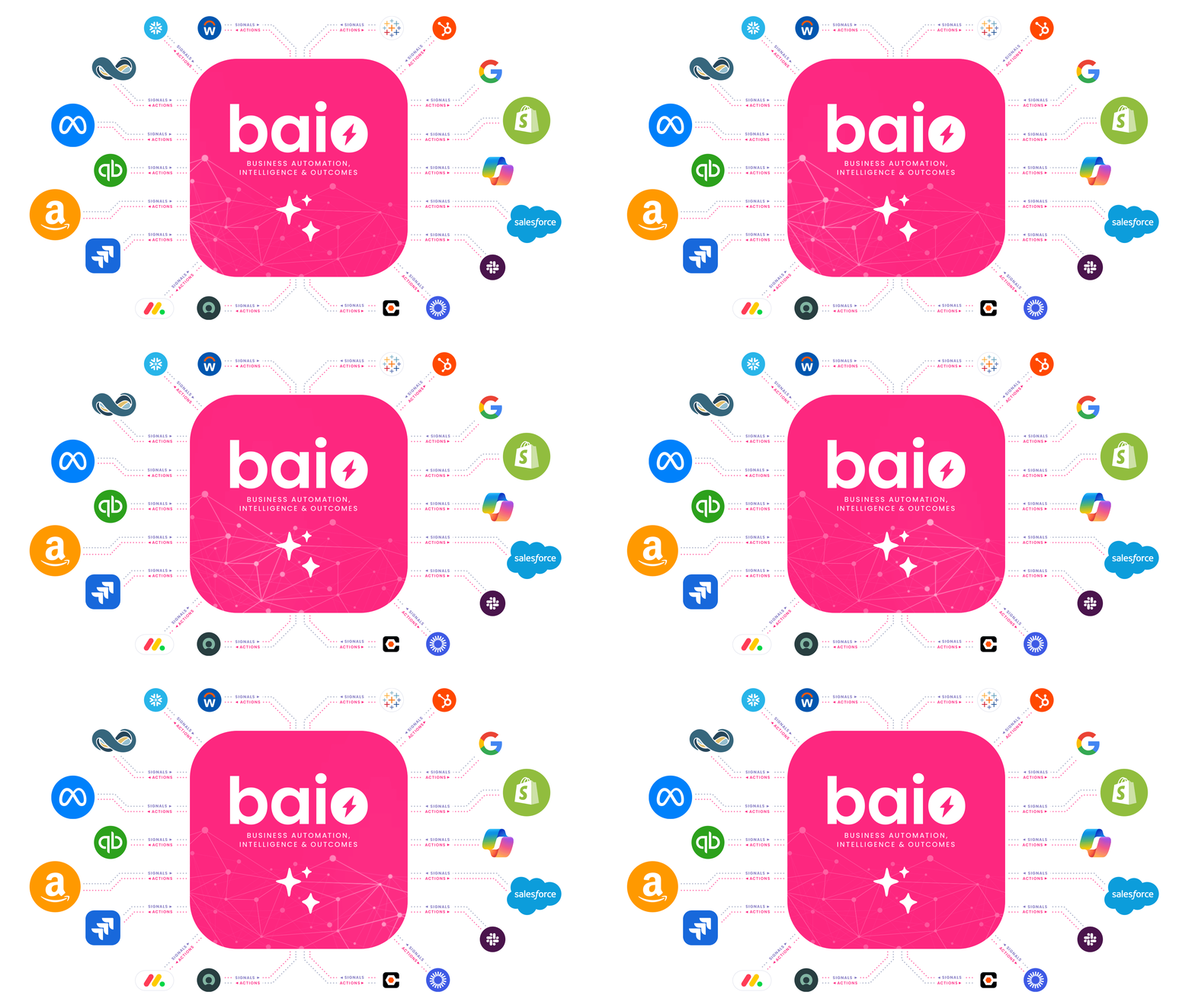
That environment is the Corporate Brain. BAIO is the Corporate Brain for your company: not a tool added to the ones you have, but the place where the intelligence each function generates becomes visible to the whole.
Consider what happened when Mugsy CEO Leo Tropeano faced a Black Friday promotion that had gone flat, with Cyber Monday 24 hours out.
He didn't convene a committee or wait for four departments to reconcile their spreadsheets. He asked a question inside the Corporate Brain and got the right SKU, the right discount depth, competitive benchmarks, and a launch window, from his own business data, in real time.
The pivot worked. The post-mortem came back in seven minutes. "Someone smarter than me," Leo said, "would have taken a day."
Notice what changed. Leo didn't get a better tool. He got a decision owner who could see everything the decision touched. That is accountability in practice.
The question for your next board meeting
When your board asks what AI is delivering, "each team is seeing gains" is not an answer. It's a list of separate answers.
The leaders in the 54% aren't wrong that something is coming apart. It isn't the technology. It's the thread of accountability that used to run from strategy to the work, and no longer does.
You can restore it. Not by adding oversight on top of fragmentation, but by giving the organization one operating picture that someone can actually own.
Book a 30-minute strategy session with Chris Happ, CEO of VirtuousAI. You'll leave with a clear view of where accountability breaks down in your company today, and what it looks like when it doesn't.