June 11, 2026

There's a question echoing in boardrooms across the country right now. Boards are asking it. CFOs are asking it. And if you're a CEO who's spent the last two years approving AI budget line by line, you're asking it too.
“Where's the return?”
Not the demo. Not the deck. Not the projected savings from a vendor who's never seen the inside of your operation.
The actual money. The measurable, defensible, show-it-to-the-board return.
And here's the uncomfortable truth: most AI tools don't have a good answer.
Let's be honest about what happened. The AI wave hit, and every software vendor in the world slapped an “AI-powered” badge on their product. Your sales team got an AI tool. Marketing got one. Finance got one. Operations got one. Each one came with a use case. Each one had a compelling demo. Each one promised to save hours, reduce errors, increase output. And most of them probably do “something” useful.
But here's the problem: useful inside a silo is not the same as valuable across a business.
When your sales AI doesn't know what your operations team is struggling with, it optimizes pipeline while you're about to miss a fulfillment deadline.
When your finance AI doesn't know what's happening in marketing, it flags budget variances that were already accounted for in a campaign nobody told it about.
When your marketing AI doesn't know what your best customers actually do after they buy, it optimizes for acquisition while your retention numbers quietly bleed out.
These tools are smart. They're just blind to everything outside their four walls.
And blind intelligence isn't intelligence. It's expensive guesswork.
Here's why so many CEOs can't produce a clean AI ROI number: they're measuring the wrong unit.
They're measuring a tool when they should be measuring an outcome.
Tools produce efficiency. Connected intelligence produces outcomes. And the difference in dollar value between those two things is an order of magnitude.
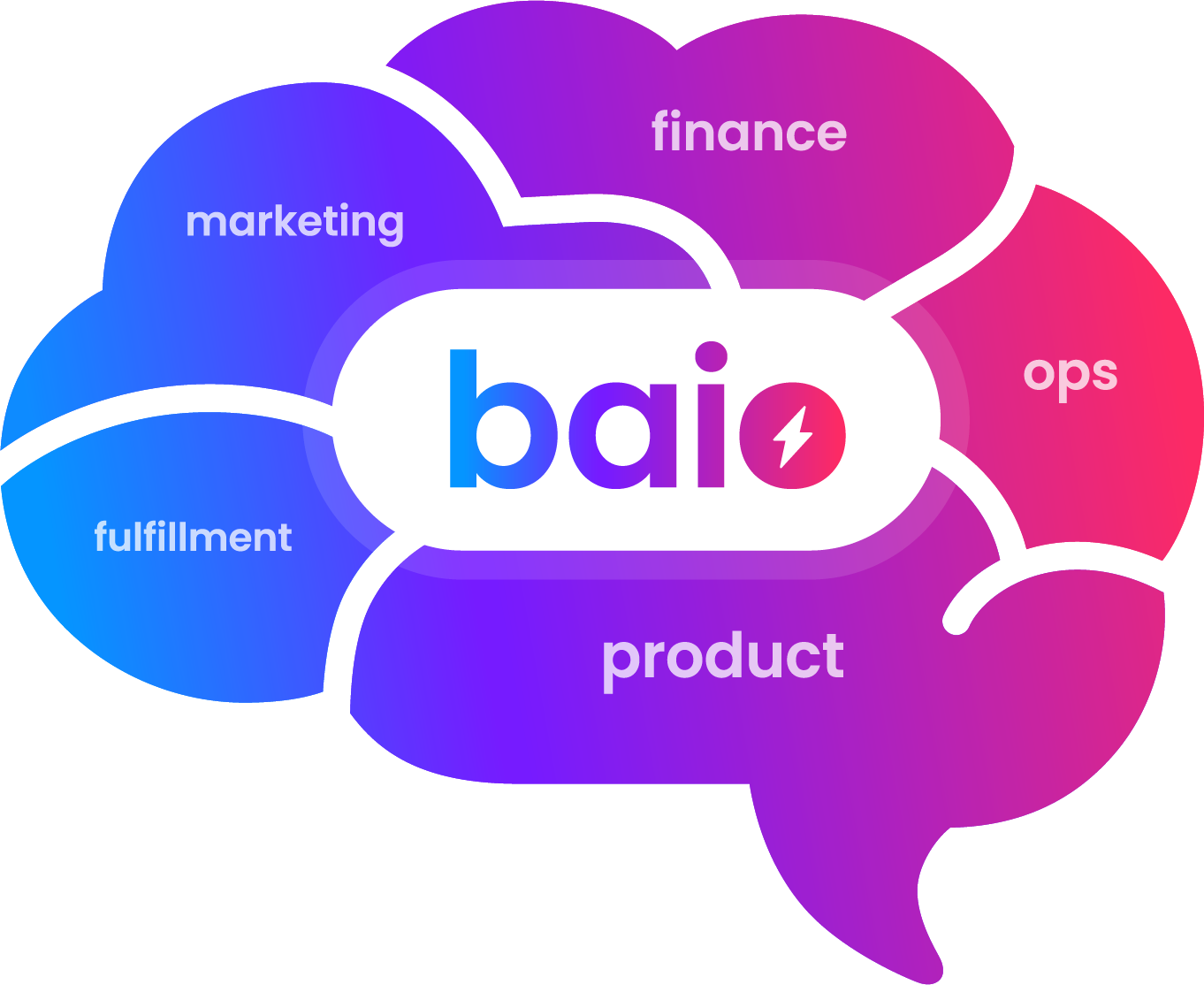
This is where BAIO is fundamentally different, and why the comparison to other AI tools is almost unfair to make. BAIO isn't a tool. It's not a copilot. It's not a chatbot with better branding.
BAIO is a corporate brain, a continuously learning intelligence layer that sits across your entire business, connecting every system you already run, and translating the signals from those systems into decisions and actions in real time.
Here's what that looks like in practice:
Every system you operate is generating signals right now.
CRM activity. Inventory levels. Customer support tickets. Marketing engagement. Cash flow position. Hiring pipeline. Supplier lead times.
Most organizations collect these signals in separate systems, review them in separate meetings, and act on them in separate workflows — weeks after the signal was relevant.
BAIO pulls all of those signals into one connected intelligence layer. It doesn't just read them. It “thinks” across them, identifying patterns, correlations, and risks that no single tool, and no single human, could spot by looking at one system at a time.
Then it acts. Automatically. Across systems. Not a report that tells you what happened. Not an alert that tells you something is wrong. An action that resolves it — or captures the opportunity — before it moves on.
So what's the ROI of BAIO?
Let's stop talking in abstractions and get specific about where measurable value lives.
Here's the test every CEO should apply to every AI investment: “Can this tool produce an outcome — not just an output — that I can trace back to a dollar?”
If your AI tools are producing outputs but not outcomes, you don't have an AI strategy. You have a subscription problem.
We see this every day. The companies getting ahead right now aren't the ones with the most tools. They're the ones who stopped buying point solutions and started building a connected intelligence layer that makes the entire business smarter.
These CEOs understand how to treat AI the way the best companies treated ERP in the 1990s: not as a department-by-department upgrade, but as a fundamental shift in how the business sees itself, operates, and competes.
The difference is that ERP connected your data. BAIO connects your intelligence.
And in 2026, that's the only AI investment that has a clear, traceable, board-presentable solution to the demand every CEO is finally saying out loud.
If your board asked you tomorrow to justify every dollar you've spent on AI in the last two years, could you do it?
Could you point to a system that connects your data, learns your business, and takes action across your operation, measurably moving revenue, cost, speed, and risk in your direction?
If not, you don't have a ROI problem. You have a strategy problem. And the solution isn't another tool. It's a corporate brain.