August 3, 2026
They’ve had their team upload documents to ChatGPT. They’ve added a chatbot to the intranet. They’ve run pilot after pilot, department by department. And when someone asks the tool a question about the business, it sounds impressive — right up until the moment it’s wrong.
Not wrong because the model is bad. Wrong because the model doesn’t actually know your business.
That distinction matters more than most CEOs realize. And closing that gap is the entire reason BAIO exists.
Let’s be clear about what we’re comparing — without the jargon.
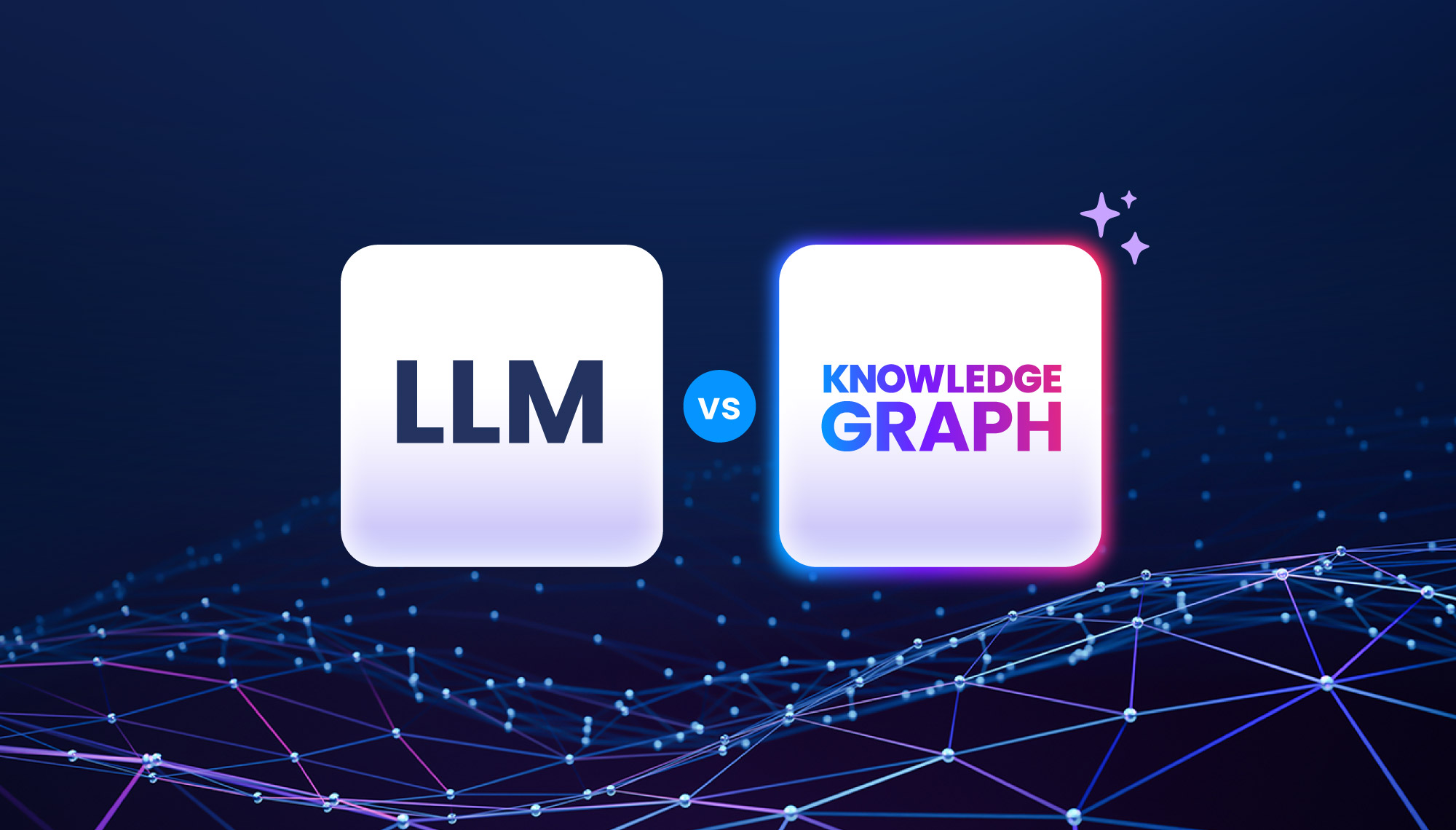
A large language model (LLM) – think ChatGPT, Claude, Gemini — is a prediction engine trained on the internet. It knows a lot about a lot of things. It can write, summarize, explain, and generate. It’s extraordinarily good at processing language.
What it doesn't have: any knowledge of your company. Your deals. Your customers. Your institutional memory. Your decisions and why you made them. Your competitive intelligence. Your SOPs built from years of hard-won experience.
When you ask an LLM about your business, it guesses. Confidently. Sometimes correctly. But it is always guessing.
A knowledge graph is different in a fundamental way. It doesn’t predict. It knows. A knowledge graph is a structured, interconnected map of your company’s actual information: entities, relationships, rules, outcomes, and context, all linked together so that meaning compounds over time.
With a knowledge graph, your key accounts are connected to your revenue signals. Your processes are connected to your outcomes. Your people are connected to their expertise and decisions. All of it living in a system that learns.
Here’s the simplest way to say it:
An LLM is a brilliant generalist who just walked in the door. A knowledge graph is the institutional memory of a company that never forgets.
Most CEOs don’t think about it this way. They hear "AI" and they reach for the most visible AI…and that’s almost always an LLM.
So they build on top of a foundation that doesn’t know them.
The result? AI that hallucinates facts about your own products. Chatbots that give customers generic answers when your best sales rep would give them a specific, winning answer. Analysts who spend hours manually correcting AI output because the system doesn’t understand the nuance your company has spent years developing.
This is what we call the quiet failure mode of tactical AI. It looks like progress. It feels like AI adoption. But it isn’t compounding. The business isn’t getting smarter.
BAIO isn’t another AI tool layered on top of your existing operation. It’s a corporate brain, connected intelligence built specifically for how your company runs.
At its core, BAIO is built on a knowledge graph architecture. That means every piece of intelligence your company generates — every customer interaction, every deal outcome, every operational signal, every decision and its result — gets woven into a structured, growing map of your business.
And then AI is applied on top of that knowledge. Not in place of it.
The result:
That last point is where CEOs feel it most directly. Most AI tools end at the insight. BAIO ends at the outcome.
When your company has a true corporate brain, the competitive math changes.
Mugsy deployed BAIO and unlocked millions in working capital they didn't know they had. Not because the technology was magic, but because the right intelligence was finally connected to the right decisions at the right time. Check out their case study here.
That’s what a corporate brain does.
In our latest white paper, 98.5% of mid-market CEOs told us they believe AI has real value for their business. Only 7% have a company-wide strategy with multiple initiatives in place.
The gap between believing and executing? That's the Execution Gap. And it’s costing you more than you know.
The companies that close that gap now will own their category before the competition resets. The mid-market moves faster than the giants when it has the right foundation.
But you can’t close the Execution Gap with a tool that doesn't know your business. You need a brain. Your brain. Built from your knowledge, your relationships, your decisions, your outcomes.
You can keep experimenting with AI tools that reset every conversation. Tools that hallucinate your own company’s data. Tools that plateau at 10% efficiency improvements while your competitors think about how to rewire their entire business model.
Or you can put your corporate knowledge into a brain that thinks, learns, and acts on behalf of your company.
BAIO was built for exactly this moment and exactly this decision. Your company’s knowledge is your greatest competitive asset. Where it lives determines how far it can take you.
The question isn’t whether AI will reshape your industry. It will. The question is whether you’ll face that moment with a tool that guesses – or a brain that knows.